
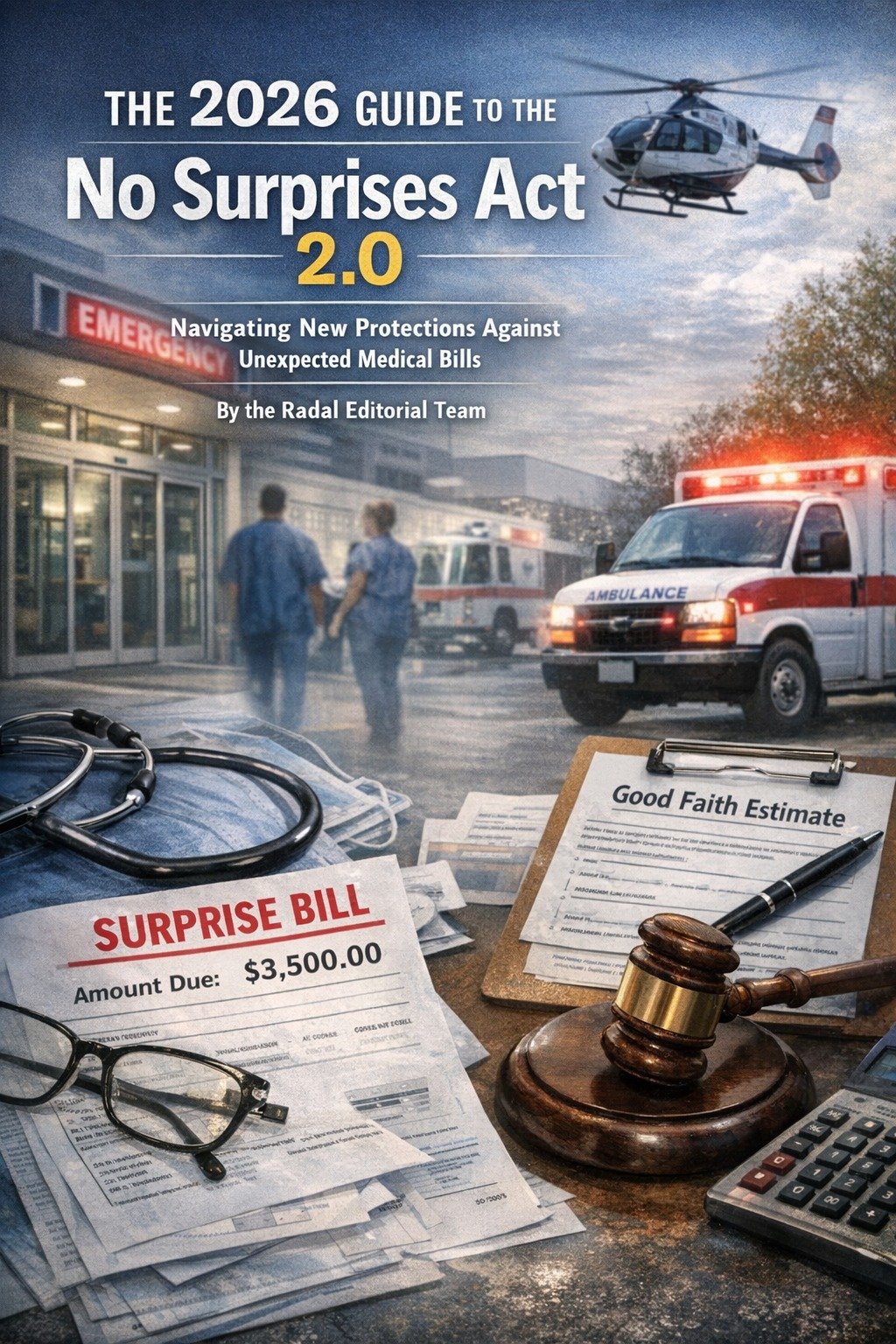
By the Radal Editorial Team
In the complex landscape of American healthcare, few things are as devastating as the “surprise medical bill.” For decades, patients undergoing planned surgeries or emergency care at in-network facilities were blindsided by out-of-network charges from providers they didn’t choose—such as anesthesiologists, radiologists, or assistant surgeons.
The original No Surprises Act (NSA), which took effect in 2022, was a landmark piece of consumer protection. However, as we move through 2026, the landscape has shifted. New regulations, court rulings, and administrative updates—often referred to as “No Surprises Act 2.0”—have refined how patients are protected and how disputes between insurers and doctors are settled.
This deep dive explores the 2026 updates to the No Surprises Act, what they mean for your wallet, and how you can exercise your rights to overturn massive medical debts.
1. What is the No Surprises Act 2.0?
The “2.0” designation isn’t a single new law passed by Congress, but rather the culmination of several Final Rules issued by the Departments of Health and Human Services (HHS), Labor, and the Treasury. These updates address the “loopholes” that emerged between 2022 and 2025.
Key Pillars of the 2026 Protections:
- Emergency Services: All emergency services must be treated as in-network, regardless of where they are provided.
- Air Ambulance Coverage: Protection against massive bills from private air ambulance companies.
- The “Independent Dispute Resolution” (IDR) Refinement: New rules on how much insurers must pay doctors, ensuring that costs aren’t passed down to the patient through higher premiums.
- Ground Ambulance Transparency: While the original act focused on air ambulances, 2026 marks a significant push toward transparency in ground ambulance billing.
2. The 2026 Independent Dispute Resolution (IDR) Overhaul
One of the most contentious parts of the original law was how doctors and insurance companies settled price disagreements. Previously, this process was backlogged, causing delays in claims processing.
In 2026, the IDR Portal has been streamlined. For the consumer, this is vital because:
- Administrative Fees are Capped: This prevents the cost of “arbitration” from being factored into your future medical costs.
- “Batching” of Claims: Providers can now group similar claims together, speeding up the process and ensuring your “Explanation of Benefits” (EOB) is accurate sooner rather than later.
- Transparency in “Qualifying Payment Amounts” (QPA): Insurers must now be more transparent about how they calculate the “median in-network rate,” which is the benchmark for what you owe.
3. Protecting the Uninsured: The “Good Faith Estimate” (GFE)
If you are uninsured or planning to pay for care out-of-pocket, the No Surprises Act 2.0 provides a powerful tool: the Good Faith Estimate.
As of 2026, healthcare providers are legally required to give you a written estimate of expected charges before you receive care. If the final bill is $400 or more above the GFE, you have the right to initiate the Patient-Provider Dispute Resolution (PPDR) process.
How to use the GFE in 2026:
- Request it early: Ask for the GFE at least three business days before your procedure.
- Check for “Hidden” Providers: Ensure the estimate includes facility fees, labs, and specialist consultations.
- The 120-Day Rule: You must initiate a dispute within 120 calendar days of receiving the final bill that exceeded the estimate.
4. Ground Ambulances: The Final Frontier
For years, ground ambulances were the “missing piece” of the No Surprises Act. While federal law in 2026 still allows for some state-level variation, the 2026 Ground Ambulance Transparency Rule requires all providers to disclose their rates publicly and report their costs to the government.
Before 2026, a 10-mile ambulance ride could result in a $2,000 “out-of-network” bill. Now, if your state hasn’t already banned these bills, the federal reporting requirements make it much easier for patients to contest “unreasonable” charges in court or through local consumer protection agencies.
5. How to Spot a “Surprise Bill” in Your Mailbox
In 2026, medical billers have become more sophisticated. A surprise bill might not look like a bill at all; it might look like a “Statement of Responsibility.”
Signs of an Illegal Surprise Bill:
- You received emergency care at an out-of-network ER, but the bill charges you “out-of-network” rates.
- You went to an in-network hospital, but the anesthesiologist or radiologist sent you a separate bill for the “balance.”
- The bill includes a “Notice and Consent” form that you don’t remember signing. (In 2026, providers cannot force you to waive your NSA protections for emergency care).
6. Step-by-Step: How to Overturn a Massive Medical Bill
If you believe you’ve been wrongly billed, follow the radal.shop 2026 Protocol:
Step 1: Do Not Pay the Bill Immediately
Paying the bill can sometimes be seen as an admission of the debt. Contact the billing department and state: “I am disputing this bill under the federal No Surprises Act.”
Step 2: Compare the EOB and the Invoice
Check your Insurance Company’s Explanation of Benefits (EOB) against the hospital’s invoice. If the EOB says you owe $50 (in-network co-pay) but the hospital asks for $1,500, the hospital is likely “balance billing” you illegally.
Step 3: Check for the “Notice and Consent”
Under the 2026 rules, providers of certain non-emergency services can only bill you at out-of-network rates if they gave you a notice 72 hours in advance and you signed it. If they gave you the form right before surgery while you were on medication, that consent is often invalid.
Step 4: Contact the CMS Help Desk
The Centers for Medicare & Medicaid Services (CMS) maintains a national “No Surprises” help desk. In 2026, they have increased staff to handle consumer complaints.
- Phone: 1-800-985-3059
- Online: Visit the CMS.gov portal to file a formal dispute.
7. The Future of Medical Billing: What’s Next?
As we look beyond 2026, the focus is shifting toward AI-driven billing audits. Consumer advocacy groups are now using AI to scan thousands of hospital bills to find patterns of “upcoding” (charging for a more expensive service than what was provided).
At radal.shop, we recommend that every patient keeps a “Medical Paper Trail.” Save every GFE, every EOB, and every piece of correspondence. In the era of the No Surprises Act 2.0, information is your best defense against medical bankruptcy.
8. Conclusion
The No Surprises Act 2.0 has fundamentally changed the power dynamic between patients and the healthcare industry. While hospitals and insurers continue to debate the finer points of “Fair Market Value,” the law is clear: The patient should not be caught in the middle.
Whether it’s a surprise $50,000 air ambulance charge or a $1,200 “facility fee” for a routine biopsy, you have the legal framework to fight back. Stay informed, demand your Good Faith Estimate, and never accept an out-of-network bill for emergency care.




Leave a Reply