

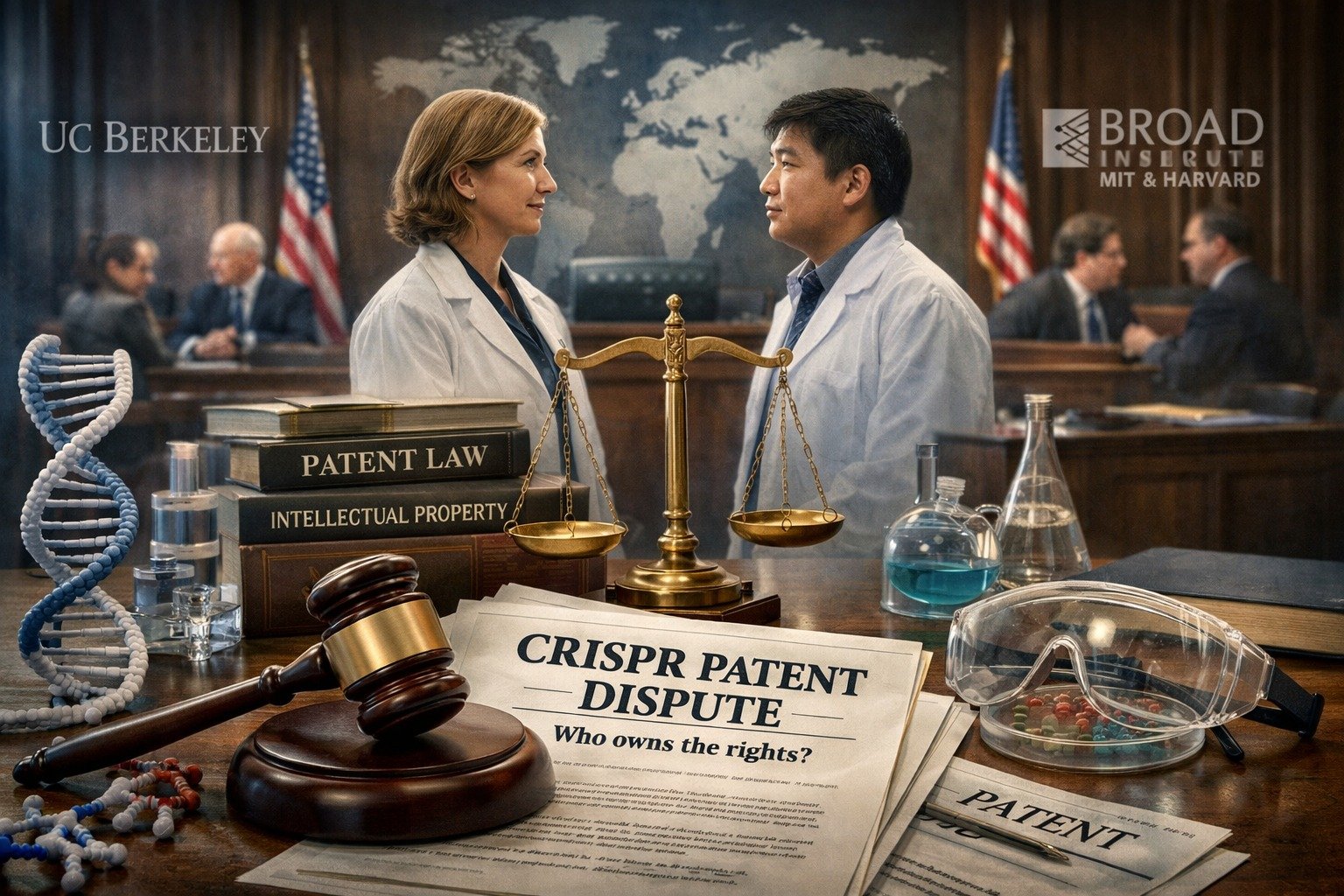
Biology has entered an era where editing DNA can be as precise as editing a sentence in a document. At the center of this revolution sits CRISPR, a gene-editing technology that allows scientists to cut and modify DNA with remarkable accuracy. It has the potential to cure genetic diseases, engineer climate-resilient crops, and reshape modern medicine.
But with transformative science comes a powerful question that echoes through courtrooms as much as laboratories: Who actually owns the rights to CRISPR technology?
The debate has evolved into one of the most significant intellectual property battles in modern science. Universities, research institutions, and biotechnology companies have fought fiercely for patent ownership, recognizing that the entity controlling CRISPR patents could influence billions of dollars in future biotech development.
This article explores the origins of CRISPR, the legal disputes surrounding its patents, the major players involved, and what these battles mean for the future of biotechnology.
The Rise of CRISPR Technology
CRISPR stands for Clustered Regularly Interspaced Short Palindromic Repeats, a mouthful that describes a naturally occurring defense system used by bacteria. Scientists discovered that bacteria use this system to identify and destroy invading viruses by cutting their genetic material.
Researchers later realized that this natural mechanism could be repurposed as a tool for editing DNA in other organisms. The process works like molecular scissors guided by a programmable sequence that targets specific genes.
The simplicity and efficiency of CRISPR transformed gene editing almost overnight. Earlier technologies such as Zinc Finger Nucleases (ZFNs) and TALENs were complex, expensive, and difficult to design. CRISPR, in contrast, was relatively easy to implement, which opened the door to rapid innovation across scientific fields.
Today CRISPR is used in research involving:
- Genetic disease treatments
- Cancer therapy development
- Crop improvement
- Livestock breeding
- Drug discovery
- Synthetic biology
Because of its enormous commercial potential, the technology quickly became the center of a high-stakes intellectual property race.
The Foundations of the CRISPR Patent Dispute
The legal battle over CRISPR patents largely centers around two scientific groups:
- A team led by Jennifer Doudna at the University of California, Berkeley and Emmanuelle Charpentier.
- A team led by Feng Zhang at the Broad Institute of MIT and Harvard.
Both groups contributed major breakthroughs to the development of CRISPR as a gene-editing tool.
In 2012, Doudna and Charpentier published groundbreaking research describing how CRISPR-Cas9 could be used to cut DNA in a controlled way. Their work demonstrated that the bacterial system could be turned into a programmable editing tool.
Soon after, Feng Zhang and colleagues demonstrated how CRISPR could successfully edit genes in eukaryotic cells, which include plants, animals, and humans. This step was crucial because medical applications require gene editing in these complex cells.
The overlapping discoveries led to a fierce patent race. Whoever secured patents first could control licensing rights and potentially generate enormous revenue from biotech companies.
Understanding Patent Rights in Biotechnology
Patents exist to protect intellectual property and encourage innovation. A patent gives the inventor exclusive rights to use, license, or sell an invention for a limited period, typically twenty years.
In biotechnology, patents can cover several aspects of a technology, including:
- The method used to edit genes
- The molecular tools involved
- Specific applications of the technology
- Modified organisms created using the technology
CRISPR patents are particularly valuable because the technology can be applied across countless industries, from pharmaceuticals to agriculture.
However, when multiple research groups claim credit for related discoveries, patent law becomes extremely complex.
The Patent Race Begins
The University of California team filed one of the earliest CRISPR patent applications in 2012, shortly after publishing their findings.
However, the Broad Institute took an unusual legal strategy. It paid for expedited patent review, allowing its applications to move through the system much faster than usual.
As a result, the Broad Institute received several CRISPR patents before the University of California’s applications were fully examined.
This move ignited a major legal conflict. The University of California argued that the Broad Institute’s patents were based on discoveries already described in their earlier research.
The dispute eventually reached the United States Patent and Trademark Office (USPTO) through a legal process known as a patent interference proceeding.
The Patent Interference Battle
Patent interference is a procedure used to determine who invented a technology first when multiple parties claim overlapping patents.
In the CRISPR case, the University of California argued that its researchers were the original inventors of the CRISPR-Cas9 editing system and therefore deserved broad patent rights covering all uses of the technology.
The Broad Institute countered that its researchers made a separate invention by adapting CRISPR to function inside eukaryotic cells. According to their argument, this step required significant additional innovation.
In 2017, the USPTO ruled in favor of the Broad Institute in the initial interference case. The decision concluded that the Broad Institute’s work in eukaryotic cells was distinct enough to warrant its own patents.
This outcome allowed the Broad Institute to maintain several key CRISPR patents in the United States.
However, the legal battle did not end there.
Continuing Appeals and Global Patent Conflicts
Patent disputes rarely conclude with a single ruling. The University of California appealed the decision, and additional interference proceedings were initiated.
At the same time, patent battles spread internationally. Patent offices in different regions evaluated the claims independently, leading to different outcomes.
For example:
- In Europe, the University of California and its partners secured several important CRISPR patents.
- Some Broad Institute patents were revoked due to technical filing issues.
- Other jurisdictions granted patents to both sides for different aspects of the technology.
The result is a complex global patent landscape where multiple institutions hold rights to different parts of CRISPR technology.
For biotechnology companies, this means navigating a complicated licensing system depending on where they operate and what applications they pursue.
Commercial Stakes in the CRISPR Patent War
The financial implications of CRISPR patents are enormous. Analysts estimate that gene-editing technologies could generate tens of billions of dollars in economic value over the coming decades.
Several biotechnology companies have already been formed around CRISPR research, including firms backed by the competing academic groups.
These companies are developing therapies for conditions such as:
- Sickle cell disease
- Genetic blindness
- Blood disorders
- Certain cancers
- Rare inherited conditions
Agricultural applications are also rapidly expanding. CRISPR can create crops with improved resistance to drought, pests, and disease, potentially transforming global food production.
Because of these possibilities, licensing CRISPR technology has become a major revenue stream for universities and research institutions.
Ethical Dimensions of CRISPR Ownership
Beyond financial considerations, the CRISPR patent debate raises important ethical questions.
Some scientists argue that life-altering technologies should not be controlled by a small group of institutions. They believe broad access to gene-editing tools is necessary to accelerate medical breakthroughs.
Others emphasize the role patents play in encouraging innovation. Without intellectual property protections, companies might be reluctant to invest billions of dollars into developing gene therapies.
There are also concerns about how CRISPR could be used. Editing human embryos, for example, remains a highly controversial topic.
In 2018, a Chinese scientist announced the birth of gene-edited babies, sparking international criticism and renewed discussions about global regulation.
The event demonstrated that scientific capabilities can sometimes advance faster than legal and ethical frameworks.
Licensing Models and Industry Impact
To manage patent rights, several institutions have created licensing frameworks allowing companies to use CRISPR technology.
These agreements often involve:
- Upfront licensing fees
- Royalty payments on products developed using the technology
- Collaborative research partnerships
Some licensing strategies aim to encourage widespread use of CRISPR while still generating revenue.
For example, certain licenses are designed specifically for non-profit research or academic studies, allowing universities to continue exploring CRISPR applications without restrictive costs.
Commercial entities, however, often face more complex negotiations when seeking to develop gene-editing therapies.
The Role of Patent Pools and Shared Innovation
Given the complexity of CRISPR patents, some experts have suggested creating patent pools.
A patent pool is a system where multiple patent holders agree to combine their intellectual property and license it collectively.
This model has been used successfully in other technology industries, such as telecommunications and video compression standards.
In biotechnology, a patent pool could simplify access to CRISPR technology by reducing legal barriers and licensing disputes.
However, establishing such agreements requires cooperation between institutions that have spent years competing in court.
CRISPR and the Future of Personalized Medicine
Despite the legal battles, CRISPR continues to advance rapidly in scientific research.
Clinical trials are already testing CRISPR-based therapies for several genetic diseases. Early results have shown promising outcomes in conditions that were previously considered untreatable.
The technology also plays a major role in personalized medicine, where treatments are tailored to an individual’s genetic profile.
In the future, doctors may use gene editing to correct mutations before they cause disease.
This possibility has profound implications for healthcare, potentially shifting medicine from treating illness to preventing it entirely.
Agricultural and Environmental Applications
CRISPR is not limited to medicine. Agriculture is another area where gene editing could have a massive impact.
Researchers are developing crops with traits such as:
- Increased yield
- Resistance to drought
- Reduced reliance on chemical pesticides
- Improved nutritional value
Gene editing may also help address environmental challenges. Scientists are exploring ways to use CRISPR to control invasive species or combat diseases affecting wildlife.
However, these applications raise regulatory and ecological questions that governments around the world are still working to address.
Lessons from the CRISPR Patent War
The CRISPR litigation saga highlights several broader lessons about innovation and intellectual property.
First, scientific breakthroughs often emerge from collaborative progress rather than a single moment of discovery. Multiple researchers may contribute essential steps toward a transformative technology.
Second, the patent system sometimes struggles to keep pace with rapidly evolving scientific fields.
Finally, the balance between protecting innovation and ensuring access to life-changing technologies remains a complex challenge.
The CRISPR dispute illustrates how legal frameworks, scientific ambition, and commercial interests intersect in the modern research landscape.
What Lies Ahead for CRISPR Ownership
The legal battles surrounding CRISPR are unlikely to disappear soon. As the technology continues to evolve, new inventions and improvements will generate additional patent filings.
Emerging tools such as base editing and prime editing, which build upon CRISPR principles, are already introducing new layers of intellectual property.
At the same time, governments and regulatory agencies are working to establish clearer guidelines for gene-editing applications.
The ultimate outcome may involve a shared ecosystem where multiple institutions hold different pieces of the CRISPR puzzle.
Rather than a single owner controlling the technology, the future may resemble a network of overlapping patents and collaborative licensing agreements.
Conclusion
CRISPR represents one of the most powerful scientific innovations of the 21st century. Its ability to precisely edit DNA has opened doors to breakthroughs in medicine, agriculture, and environmental science.
Yet alongside this scientific progress lies a complex legal struggle over who owns the rights to the technology.
The ongoing patent battles between major research institutions highlight the enormous economic and societal stakes involved. Control over CRISPR patents could shape the direction of biotechnology for decades.
While courts continue to sort through competing claims, one thing is clear: the CRISPR revolution is only beginning. The decisions made today about intellectual property, access, and regulation will influence how this remarkable technology benefits humanity in the years ahead.










Leave a Reply