

Introduction
Artificial intelligence is rapidly transforming the legal profession. Law firms around the world are beginning to integrate advanced AI tools into daily operations, using them to analyze legal documents, summarize case law, draft contracts, and even generate legal arguments. These tools promise faster research, reduced costs, and improved productivity for legal professionals.
However, alongside these benefits comes a serious new challenge: AI hallucinations. In artificial intelligence systems, hallucinations occur when a model generates information that appears convincing but is actually incorrect, fabricated, or unsupported by real data.
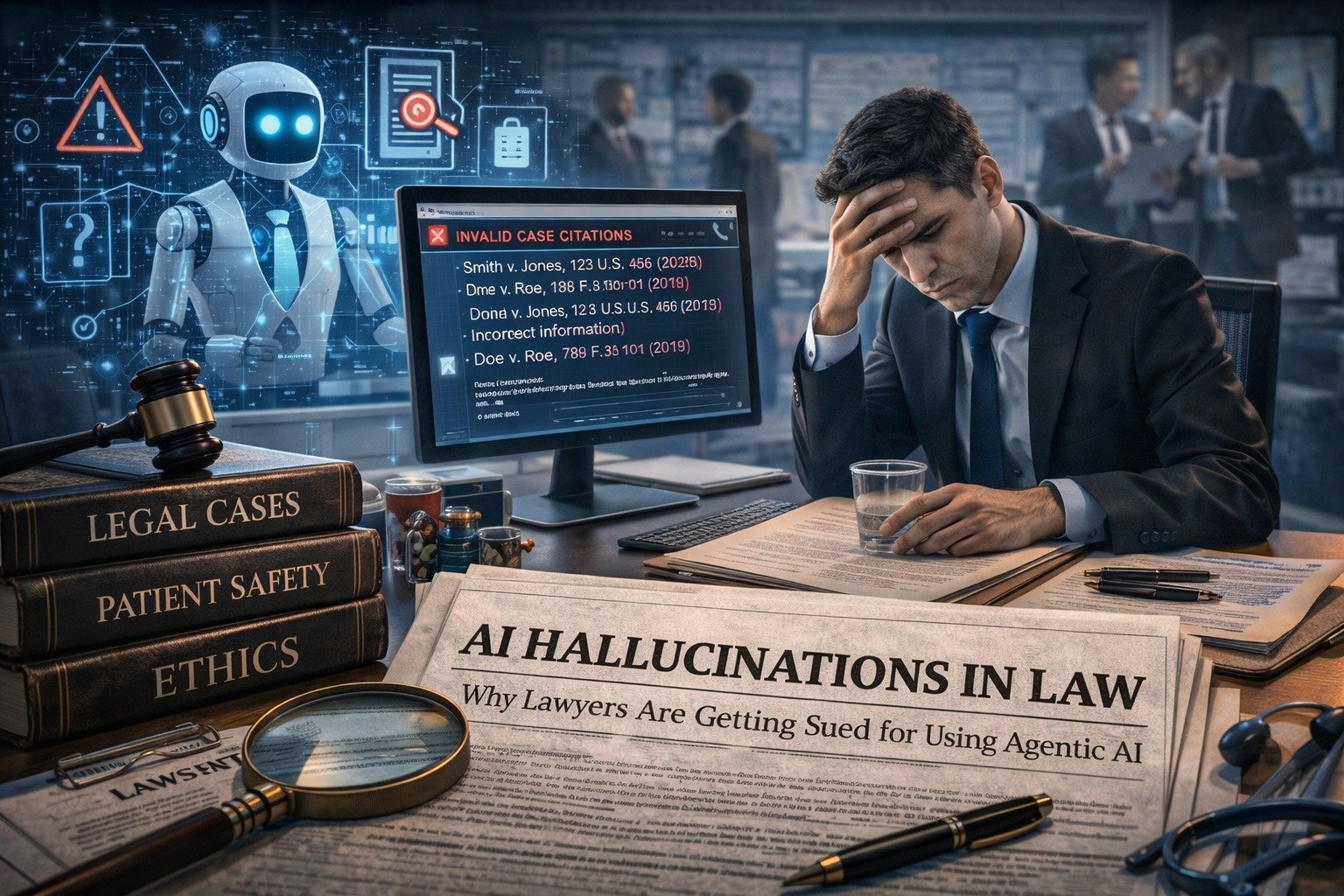
In the legal field, this problem has already led to real-world consequences. Several lawyers have faced court sanctions, disciplinary actions, and lawsuits after submitting AI-generated legal documents containing fake citations and nonexistent case law. As AI tools become more sophisticated and autonomous, the risks associated with these errors are growing.
The rise of agentic AI systems, which can perform complex tasks with minimal human supervision, has intensified these concerns. While these systems can automate large portions of legal work, they may also introduce errors that are difficult to detect without careful review.
This article explores the phenomenon of AI hallucinations in legal practice, examines why lawyers are being sued for relying on AI-generated content, and discusses the legal and ethical challenges facing the legal profession in the age of artificial intelligence.
The Rise of Artificial Intelligence in Legal Practice
Artificial intelligence has become increasingly common in the legal industry over the past decade. Legal technology companies have developed AI-powered tools designed to streamline many aspects of legal work.
These technologies can perform tasks such as:
- Legal research and case law analysis
- Document review and contract analysis
- Litigation prediction and analytics
- Drafting legal memos and briefs
- Due diligence in corporate transactions
Law firms are drawn to these tools because they can dramatically reduce the time required for research and document preparation. Tasks that once took hours or days can sometimes be completed in minutes using AI systems.
As competition within the legal industry intensifies, many firms are adopting AI technologies to remain efficient and competitive.
What Are AI Hallucinations?
AI hallucinations occur when a machine learning model generates information that is false or fabricated but presented as factual.
These errors arise from the way large language models are trained. AI systems learn patterns from massive datasets of text, but they do not truly understand the information they generate. Instead, they predict likely word sequences based on statistical probabilities.
As a result, AI systems may sometimes produce:
- Incorrect legal interpretations
- Fabricated case law citations
- Misquoted legal statutes
- Inaccurate summaries of legal precedents
Because these responses often sound authoritative and convincing, users may assume they are accurate without verifying them.
In the legal field, where accuracy is critical, such mistakes can have serious consequences.
Agentic AI and Autonomous Legal Workflows
Recent developments in artificial intelligence have introduced agentic AI systems, which are capable of performing complex multi-step tasks with limited human intervention.
Unlike basic AI tools that respond to direct prompts, agentic systems can:
- Conduct independent legal research
- Retrieve and analyze documents
- Generate drafts of legal filings
- Make recommendations based on data analysis
These systems often operate as automated assistants that carry out tasks on behalf of users.
While this automation offers significant efficiency gains, it also increases the risk that errors will go unnoticed.
If a lawyer relies heavily on an autonomous AI system without verifying its outputs, hallucinated information may be incorporated into official legal documents.
Real-World Legal Incidents Involving AI Hallucinations
Several high-profile incidents have highlighted the dangers of AI hallucinations in legal practice.
In some cases, lawyers have submitted court filings containing citations to legal cases that do not exist. These fabricated citations were generated by AI tools and were not verified before submission.
When judges investigated the filings, they discovered that the cited cases could not be found in legal databases. Courts responded by issuing sanctions against the attorneys responsible.
These incidents have sparked widespread discussion within the legal community about the risks of using AI tools without proper oversight.
Professional Responsibility and Legal Ethics
Lawyers are bound by strict ethical obligations that require them to provide competent and accurate legal representation.
Professional conduct rules typically require attorneys to:
- Verify the accuracy of legal citations
- Conduct independent legal research
- Avoid submitting misleading information to courts
- Maintain competence in legal practice
When attorneys rely on AI-generated information without verifying its accuracy, they may violate these professional responsibilities.
Courts and legal ethics boards have begun emphasizing that lawyers remain fully responsible for the work they submit, regardless of whether it was generated by AI tools.
Legal Liability for AI-Generated Errors
When AI-generated errors cause harm to clients or affect legal proceedings, lawyers may face several forms of liability.
Malpractice Claims
Clients may sue attorneys for legal malpractice if inaccurate AI-generated information leads to unfavorable case outcomes.
Court Sanctions
Judges may impose sanctions for submitting false or misleading legal arguments.
Professional Discipline
Bar associations may investigate attorneys who fail to meet professional competence standards.
Reputational Damage
Legal professionals who rely on unverified AI outputs may face reputational harm within the legal community.
These risks highlight the importance of maintaining human oversight when using AI in legal work.
The Responsibility of Law Firms
While individual attorneys are responsible for their work, law firms also play a role in managing AI-related risks.
Firms adopting AI tools must establish clear policies governing their use.
Key considerations include:
- Training lawyers to verify AI-generated outputs
- Implementing internal review processes
- Limiting AI use for certain legal tasks
- Ensuring compliance with professional ethics standards
Proper oversight can reduce the risk of errors while still allowing firms to benefit from AI technology.
The Role of AI Developers
Technology companies that develop legal AI tools also face scrutiny regarding the accuracy and reliability of their systems.
Developers must consider issues such as:
- Transparency about AI limitations
- Clear warnings about hallucination risks
- Built-in verification features
- Access to reliable legal databases
Some legal AI platforms are beginning to integrate systems that link generated content directly to verified legal sources.
These features can help reduce the risk of fabricated citations.
Regulatory Responses
Governments and legal regulators are beginning to address the risks associated with AI in the legal profession.
Possible regulatory approaches include:
AI Usage Guidelines
Bar associations may issue guidelines for responsible AI use by lawyers.
Disclosure Requirements
Courts may require lawyers to disclose when AI tools were used in preparing legal filings.
Certification Standards
AI legal tools may eventually require certification to ensure reliability.
Ethical Training
Legal education programs may incorporate training on AI risks and responsibilities.
These measures aim to balance technological innovation with professional accountability.
The Future of AI in Legal Practice
Despite the challenges posed by hallucinations, artificial intelligence is likely to remain a central part of the legal profession.
AI tools offer significant benefits, including:
- Faster document analysis
- Improved access to legal information
- Enhanced litigation analytics
- Reduced administrative workloads
As technology improves, developers are working to reduce hallucination rates through improved training data, better model design, and integrated verification systems.
Future AI tools may combine language models with trusted legal databases to ensure that generated citations are accurate and verifiable.
Balancing Innovation and Responsibility
The rise of AI in law reflects a broader trend of digital transformation across professional industries.
However, the legal profession must approach this transformation carefully.
While AI can assist lawyers in performing research and drafting documents, it cannot replace the professional judgment and ethical responsibility that human attorneys provide.
Lawyers must remain vigilant in verifying AI-generated information and ensuring that all legal filings meet professional standards.
Ultimately, technology should enhance legal practice rather than compromise its integrity.
Ethical Considerations for the Legal Profession
The integration of AI into legal practice also raises broader ethical questions.
Transparency
Clients should be informed when AI tools are used in legal work.
Accountability
Lawyers must remain accountable for the accuracy of all legal documents.
Fair Access to Justice
AI technologies should improve access to legal services without creating new inequalities.
Professional Integrity
Legal professionals must ensure that technological convenience does not undermine ethical obligations.
Addressing these issues will be essential as AI continues to reshape the legal landscape.
Conclusion
Artificial intelligence is transforming the legal profession in profound ways. From legal research to document drafting, AI-powered tools offer unprecedented efficiency and productivity.
However, the phenomenon of AI hallucinations presents serious risks when these tools generate inaccurate or fabricated information.
Recent legal incidents involving AI-generated fake citations have demonstrated that reliance on AI without verification can lead to sanctions, malpractice claims, and reputational damage.
As agentic AI systems become more capable and autonomous, the importance of human oversight will only increase.
Lawyers, law firms, technology developers, and regulators must work together to establish responsible frameworks for AI use in legal practice.
By combining technological innovation with professional responsibility, the legal profession can harness the benefits of artificial intelligence while protecting the integrity of the justice system.













Leave a Reply