

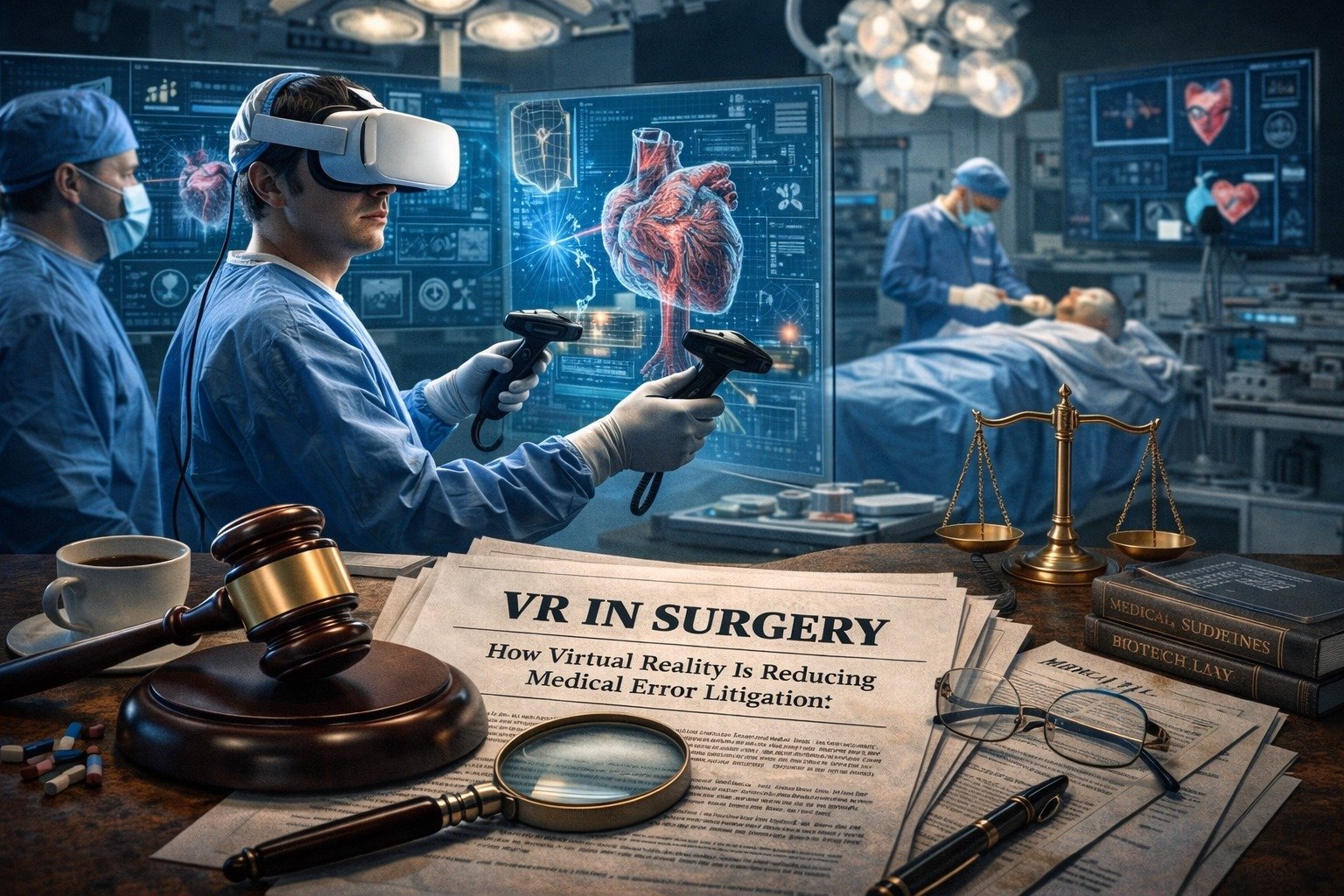
Inside a modern operating room, precision is everything. A surgeon’s decisions must be swift, accurate, and carefully coordinated with an entire medical team. Even small mistakes can lead to serious consequences for patients and potentially trigger medical malpractice lawsuits. For decades, hospitals have searched for ways to reduce surgical errors and improve patient safety.
One technology is rapidly emerging as a powerful tool in this effort: virtual reality (VR).
Virtual reality allows surgeons to step into immersive digital environments where they can practice procedures, study anatomy in three dimensions, and simulate complex surgical scenarios before entering the operating room. By transforming medical education and surgical planning, VR is helping doctors improve performance while reducing the likelihood of costly medical errors.
As healthcare systems increasingly adopt virtual reality tools, legal experts are beginning to recognize another important benefit: VR training and simulation may significantly reduce medical malpractice litigation. By enhancing surgical preparation, improving decision-making, and documenting training standards, VR is reshaping how hospitals approach both patient safety and legal risk management.
This article explores how virtual reality is changing surgical practice and how it may reduce the frequency of medical error lawsuits in the healthcare industry.
The Problem of Medical Errors in Surgery
Medical errors remain one of the leading challenges in modern healthcare. Studies have estimated that preventable medical mistakes contribute to thousands of patient injuries each year worldwide.
In surgical settings, errors may include:
Incorrect surgical techniques
Damage to surrounding tissues or organs
Miscommunication between surgical staff
Poor preoperative planning
Inadequate training or experience
When such errors occur, patients or their families may pursue medical malpractice litigation, claiming negligence or failure to meet accepted medical standards.
Malpractice lawsuits can have serious consequences for healthcare institutions, including:
Financial settlements and legal costs
Damage to professional reputations
Increased insurance premiums
Regulatory investigations
Because of these risks, hospitals are increasingly investing in technologies designed to improve surgical training and reduce mistakes.
What Is Virtual Reality in Medicine?
Virtual reality is a technology that creates immersive digital environments using specialized headsets and interactive software. Users experience a simulated world that responds to their movements and actions.
In medical applications, VR systems allow surgeons to interact with highly detailed virtual models of the human body. These models can simulate organs, tissues, and surgical instruments with remarkable realism.
VR systems used in surgery often include:
3D anatomical models
Haptic feedback devices that simulate touch
Motion tracking systems
Realistic surgical scenarios
These technologies enable surgeons to practice procedures in safe virtual environments where mistakes carry no risk to real patients.
VR Training for Surgeons
One of the most significant uses of VR in medicine is surgical training.
Traditionally, medical students and residents learn surgical techniques through a combination of classroom education, observation, and supervised procedures on real patients. While this approach has been effective for decades, it also presents challenges.
Young surgeons may have limited opportunities to practice complex procedures before performing them on patients.
Virtual reality changes this dynamic by allowing surgeons to perform simulated procedures repeatedly until they develop mastery.
Advantages of VR Training
VR-based surgical training offers several benefits:
Repetition without risk
Surgeons can repeat procedures many times without endangering patients.
Realistic anatomical visualization
Three-dimensional models allow surgeons to understand complex anatomy more clearly.
Immediate feedback
Training systems can analyze performance and highlight mistakes.
Standardized education
VR platforms ensure consistent training experiences across medical institutions.
These advantages make VR an increasingly valuable component of modern medical education.
Preoperative Surgical Planning with VR
Virtual reality is not only useful for training new surgeons. Experienced physicians are also using VR to plan complicated procedures.
Before surgery, doctors can upload patient imaging data from MRI or CT scans into VR systems. This creates detailed three-dimensional models of the patient’s anatomy.
Using these models, surgeons can:
Examine organs from multiple angles
Identify potential complications
Map surgical pathways
Rehearse the procedure virtually
This preparation allows surgeons to anticipate challenges before entering the operating room.
By reducing uncertainty during surgery, VR planning can significantly lower the risk of complications.
How VR Improves Surgical Precision
Virtual reality improves surgical outcomes by strengthening several critical aspects of surgical performance.
Enhanced Spatial Awareness
Traditional medical imaging often displays anatomy in two-dimensional slices. VR allows surgeons to visualize structures in three dimensions, improving their understanding of spatial relationships between organs and tissues.
Muscle Memory Development
Repeated VR practice helps surgeons develop muscle memory for specific surgical movements. This familiarity can lead to faster and more accurate performance during real procedures.
Decision-Making Under Pressure
VR simulations can recreate high-pressure surgical scenarios, including unexpected complications. Practicing these situations prepares surgeons to make better decisions in real emergencies.
Together, these improvements help reduce the likelihood of errors during surgery.
VR and Medical Malpractice Litigation
Medical malpractice lawsuits often arise when patients believe a healthcare provider failed to meet the accepted standard of care.
Virtual reality training may help reduce litigation in several ways.
Improved Training Standards
Hospitals that adopt VR training programs can demonstrate that surgeons receive advanced preparation before performing procedures.
This evidence may strengthen a hospital’s defense if malpractice claims arise.
Reduced Surgical Complications
Better training and planning naturally lead to fewer surgical mistakes, lowering the number of malpractice cases.
Documentation of Competence
Some VR platforms track performance data during training sessions. This data can document a surgeon’s proficiency and compliance with training requirements.
Such records may be valuable in legal proceedings.
Enhanced Patient Confidence
Patients may feel more comfortable knowing their surgeons trained using advanced simulation technologies.
Greater patient trust can sometimes reduce the likelihood of lawsuits.
VR in Surgical Education
Medical schools and teaching hospitals are increasingly integrating VR into surgical education programs.
Students can use VR systems to:
Explore anatomical structures
Practice surgical techniques
Participate in simulated procedures
Receive real-time performance evaluations
Because VR simulations can replicate rare or complex cases, students gain exposure to situations they might not encounter during traditional clinical training.
This expanded experience can help produce more competent surgeons.
Collaboration and Remote Surgery Training
Virtual reality also supports collaboration between surgeons in different locations.
Using networked VR systems, specialists can join shared virtual environments where they examine anatomical models and discuss surgical strategies.
This capability is particularly valuable for:
International medical education
Remote surgical mentoring
Complex case consultations
Such collaboration allows less experienced surgeons to learn directly from leading experts around the world.
Legal and Regulatory Considerations
While VR offers significant benefits, it also introduces new legal and regulatory questions.
Training Standards
Regulators must determine whether VR-based training should become a required component of surgical education.
Liability Issues
If a surgeon trained primarily using VR makes a mistake during surgery, legal experts may question whether the training was sufficient.
Certification Requirements
Medical boards may eventually develop certification programs for VR-based surgical training.
Data Privacy
Some VR systems store patient imaging data for surgical planning. Hospitals must ensure that these systems comply with healthcare privacy regulations.
Addressing these issues will be essential as VR technology becomes more widespread.
The Role of Artificial Intelligence in VR Surgery
Artificial intelligence is increasingly integrated into VR surgical platforms.
AI systems can analyze surgical performance during simulations and provide detailed feedback.
For example, AI may evaluate:
Precision of surgical movements
Time required to complete procedures
Errors made during simulations
Efficiency of instrument use
These insights help surgeons refine their techniques and improve performance.
In the future, AI-driven VR systems may even generate personalized training programs tailored to individual surgeons.
Economic Benefits for Healthcare Systems
Medical malpractice litigation can cost healthcare systems billions of dollars annually.
By reducing surgical errors, VR technologies may also lower legal expenses.
Hospitals adopting VR training programs may experience:
Fewer malpractice claims
Reduced insurance premiums
Improved patient outcomes
Enhanced institutional reputation
Although VR systems require initial investment, many healthcare institutions view them as cost-effective long-term solutions.
The Future of VR in Surgical Medicine
Virtual reality technology continues to evolve rapidly. Future developments may include:
Hyper-realistic simulations
Advances in graphics and haptic feedback may create surgical simulations that feel nearly identical to real procedures.
Integration with robotics
VR may be combined with robotic surgical systems to enhance precision and control.
Personalized surgical rehearsal
Surgeons may routinely practice procedures on patient-specific VR models before performing operations.
Global medical training networks
VR platforms could connect surgeons worldwide for collaborative training and knowledge sharing.
These innovations may further transform surgical practice and reduce medical errors.
Ethical Considerations
As VR becomes more integrated into healthcare, ethical questions will also emerge.
Hospitals must ensure that VR training complements rather than replaces traditional clinical experience.
Patients should also be informed when VR technology plays a role in surgical planning or training.
Transparency and ethical oversight will help maintain public trust in emerging medical technologies.
Conclusion
Virtual reality is revolutionizing the field of surgical medicine. By providing immersive training environments and advanced preoperative planning tools, VR allows surgeons to refine their skills and prepare for complex procedures more effectively than ever before.
These improvements in surgical training and planning have significant legal implications. As VR helps reduce medical errors and enhance documentation of professional competence, it may also lower the number of malpractice lawsuits facing healthcare providers.
While regulatory and ethical challenges remain, the integration of VR into medical education and surgical practice represents a major step forward in patient safety.
In the future, virtual reality may become a standard component of surgical training worldwide, helping doctors perform safer procedures while protecting both patients and healthcare institutions from preventable errors.
As technology continues to advance, the operating room of tomorrow may begin long before the first incision is made—inside a virtual environment where surgeons can perfect their skills without risk.













Leave a Reply