

Introduction
Every second, millions of people around the world wear devices that quietly listen to their bodies. Smartwatches track heartbeats, fitness bands record sleep cycles, and mobile health apps monitor everything from stress levels to blood oxygen saturation. These technologies have transformed personal health monitoring, allowing individuals to understand their bodies in ways that were once only possible in hospitals.
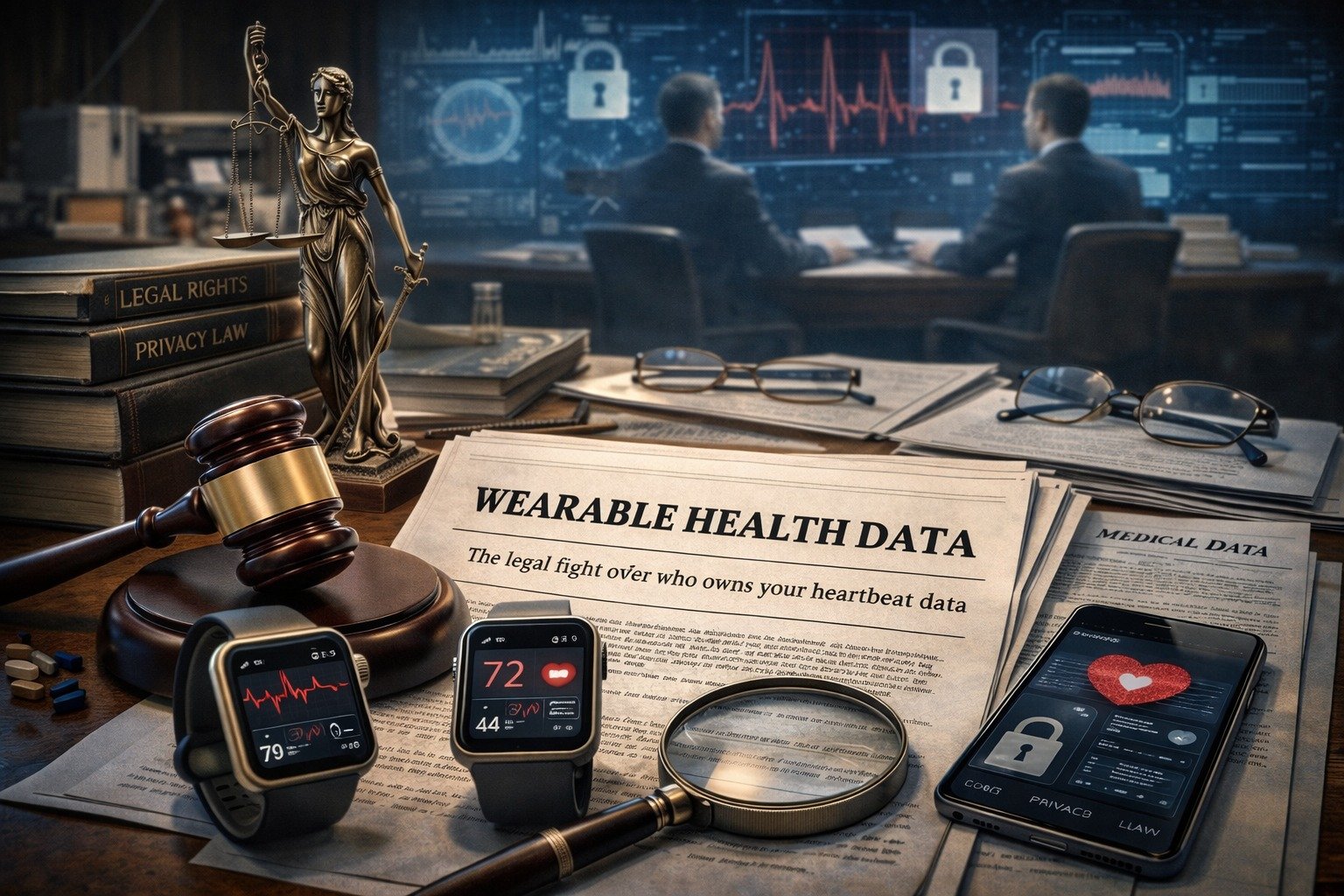
But beneath this wave of innovation lies an increasingly important legal question: Who actually owns the health data collected by wearable devices?
When your smartwatch records your heart rate or sleep pattern, that information becomes part of a digital record of your biological life. Technology companies store and analyze these records to improve products, develop medical insights, and sometimes even sell aggregated data to third parties. Meanwhile, healthcare providers, insurers, and researchers see enormous value in this data for predicting diseases and improving treatments.
The problem is that existing privacy laws were not designed for a world where consumer gadgets constantly collect biometric information. As wearable technology becomes more advanced, governments, courts, and regulators are struggling to determine who controls the data generated by the human body.
This article explores the growing legal battle over wearable health data ownership, examining privacy concerns, regulatory frameworks, corporate practices, and the future of digital health rights.
The Rise of Wearable Health Technology
Wearable health devices have rapidly evolved over the past decade. What began as simple step counters has become a sophisticated ecosystem of biometric sensors capable of tracking numerous physiological signals.
Modern wearable devices can monitor:
- Heart rate and heart rate variability
- Sleep patterns and sleep quality
- Physical activity levels
- Blood oxygen levels
- Stress indicators
- Body temperature
- Electrocardiogram (ECG) signals
These technologies generate enormous volumes of biometric data, which refers to information related to an individual’s biological characteristics.
The global wearable health technology market has expanded dramatically as consumers become more health conscious and digital health tools become more affordable. Millions of people now rely on wearable devices not only for fitness tracking but also for early detection of potential health problems.
This shift toward continuous health monitoring represents a major change in how health information is produced and stored.
What Is Heartbeat Data and Why It Matters
Heartbeat data, often measured as heart rate or heart rate variability, is one of the most commonly collected forms of biometric data in wearable devices.
Heart rate monitoring works through sensors that detect changes in blood flow under the skin using optical technology known as photoplethysmography (PPG). These sensors emit light into the skin and measure how blood circulation changes with each heartbeat.
Although heart rate data may seem simple, it can reveal surprisingly detailed insights about a person’s health and behavior. For example, heart rate patterns can indicate:
- Cardiovascular health
- Stress levels
- Sleep quality
- Physical fitness
- Emotional responses
When combined with artificial intelligence and large datasets, wearable health data can even help predict medical conditions before symptoms appear.
However, the same insights that benefit healthcare also make biometric data extremely valuable for corporations and researchers.
The Expanding Data Economy
Data has become one of the most valuable commodities in the digital economy. Technology companies rely heavily on user data to develop new products, train algorithms, and generate revenue.
Wearable health data is particularly valuable because it provides continuous, real-world biological information about millions of users.
Companies can use aggregated health data to:
- Improve fitness algorithms
- Develop predictive health tools
- Train machine learning systems
- Conduct medical research
- Identify health trends across populations
In some cases, anonymized health data may also be shared with research institutions, pharmaceutical companies, or public health organizations.
While many companies claim that shared data is anonymized, privacy experts warn that biometric data can sometimes be re-identified when combined with other datasets.
This creates new challenges for protecting personal privacy.
Who Legally Owns Wearable Health Data?
One of the most controversial questions surrounding wearable technology is data ownership.
Most users assume that because the data comes from their own bodies, they automatically own it. In reality, the situation is more complicated.
Ownership rights often depend on several factors:
- The device manufacturer
- The terms of service agreement
- The software platform storing the data
- Applicable privacy laws
In many cases, users technically retain ownership of their raw health data, but companies obtain broad rights to store, analyze, and use the information through user agreements.
These agreements are typically accepted when users activate devices or install companion mobile applications.
As a result, companies may legally process wearable health data in ways that many users do not fully understand.
Privacy Concerns in Wearable Health Technology
Wearable health devices collect highly sensitive information that goes beyond traditional digital data.
Unlike browsing history or location tracking, biometric data reflects physical and biological characteristics that cannot easily be changed.
Privacy concerns surrounding wearable health data include:
Continuous Monitoring
Wearable devices collect health data around the clock, creating detailed profiles of users’ lifestyles and behaviors.
Sensitive Health Insights
Heart rate data and other biometric signals may reveal information about medical conditions, mental health, or stress levels.
Data Sharing Practices
Some companies share anonymized health data with research partners or advertisers.
Long-Term Data Storage
Health data may be stored indefinitely on company servers or cloud platforms.
These concerns have prompted growing calls for stronger privacy protections.
Healthcare Laws and Wearable Data
One of the biggest legal challenges surrounding wearable health data is that many existing healthcare laws do not apply to consumer technology companies.
For example, the Health Insurance Portability and Accountability Act (HIPAA) in the United States protects medical records handled by healthcare providers and insurers. However, wearable device manufacturers are usually not classified as healthcare entities.
This means that health data collected by consumer devices may fall outside traditional medical privacy protections.
As a result, technology companies may operate under different legal standards than hospitals or clinics when handling sensitive health information.
International Privacy Regulations
Different regions of the world have begun introducing laws that affect wearable health data.
European Union
The General Data Protection Regulation (GDPR) treats biometric data as a special category of sensitive personal data.
Companies operating in the EU must obtain explicit user consent before processing such information and must provide transparency about how data is used.
United States
The U.S. currently relies on a combination of sector-specific laws and state regulations. Some states have introduced biometric privacy laws requiring companies to obtain user consent before collecting biometric data.
Emerging Regulations
As wearable health technology continues to expand, more countries are exploring laws specifically designed to regulate digital health platforms and biometric data usage.
These regulations aim to balance innovation with privacy protection.
Insurance and Employment Concerns
Wearable health data can also affect areas beyond healthcare.
Insurance companies may see wearable data as a tool for assessing risk or encouraging healthier lifestyles. Some insurers already offer programs that reward users for sharing activity data from fitness trackers.
However, critics worry that this could lead to discrimination.
For example, insurers might eventually use wearable data to adjust premiums based on lifestyle patterns or health indicators.
Employers have also experimented with wellness programs involving wearable devices. While these programs aim to improve employee health, they raise concerns about workplace surveillance and privacy.
Without proper safeguards, biometric data could influence decisions about employment or insurance coverage.
Data Security Risks
Another major issue in wearable health technology is cybersecurity.
Because wearable devices connect to smartphones, cloud servers, and healthcare platforms, they create multiple points where data could be intercepted or stolen.
Potential risks include:
- Unauthorized access to health databases
- Data breaches exposing sensitive health records
- Hacking of wearable devices
- Interception of data transmissions
Although companies invest heavily in security systems, no digital platform is completely immune to cyber threats.
The sensitivity of biometric data makes these risks particularly serious.
Ethical Questions in the Digital Health Era
Beyond legal issues, wearable health technology raises broader ethical questions about personal autonomy and human dignity.
Personal Control
Users should have clear control over how their health data is used and shared.
Transparency
Companies must communicate data practices in ways that ordinary users can understand.
Fair Use
Health data should not be used in ways that harm individuals through discrimination or exploitation.
Public Benefit
At the same time, responsibly shared health data can support medical research and public health initiatives.
Balancing individual rights with societal benefits remains a major ethical challenge.
The Future of Wearable Health Data Governance
As wearable devices become more advanced, policymakers will need to create new legal frameworks for biometric data protection.
Experts suggest several potential reforms:
- Recognizing wearable health data as sensitive personal information
- Strengthening consent requirements for biometric data collection
- Establishing clearer data ownership rights for users
- Creating stricter rules for data sharing and commercialization
- Developing stronger cybersecurity standards for health devices
These measures could help ensure that wearable technology continues to improve healthcare while protecting user privacy.
The Growing Importance of Digital Health Rights
The debate over wearable health data is part of a larger conversation about digital health rights.
As technology becomes more integrated with the human body, questions of data ownership, privacy, and autonomy will become increasingly important.
Individuals may eventually demand stronger rights over their biological data, similar to how societies have developed protections for personal information online.
Future legal systems may recognize biometric data as a fundamental extension of personal identity.
Conclusion
Wearable health technology has revolutionized personal healthcare by allowing individuals to monitor their bodies in real time. Devices that track heartbeats, sleep patterns, and activity levels provide valuable insights that can improve health and detect disease early.
However, the rise of these technologies has also created a new frontier in data privacy law.
Heartbeat data and other biometric signals are deeply personal forms of information, yet the legal frameworks governing their use remain incomplete. Technology companies, healthcare providers, insurers, and governments all have competing interests in accessing and analyzing this data.
The ongoing legal debate over wearable health data ownership reflects a broader challenge of the digital age: determining who controls information generated by the human body.
As wearable technology continues to evolve, societies must develop legal protections that preserve both innovation and individual rights. Only by establishing clear standards for privacy, ownership, and ethical use can we ensure that the benefits of digital health technologies truly serve the people whose data makes them possible.














Leave a Reply