

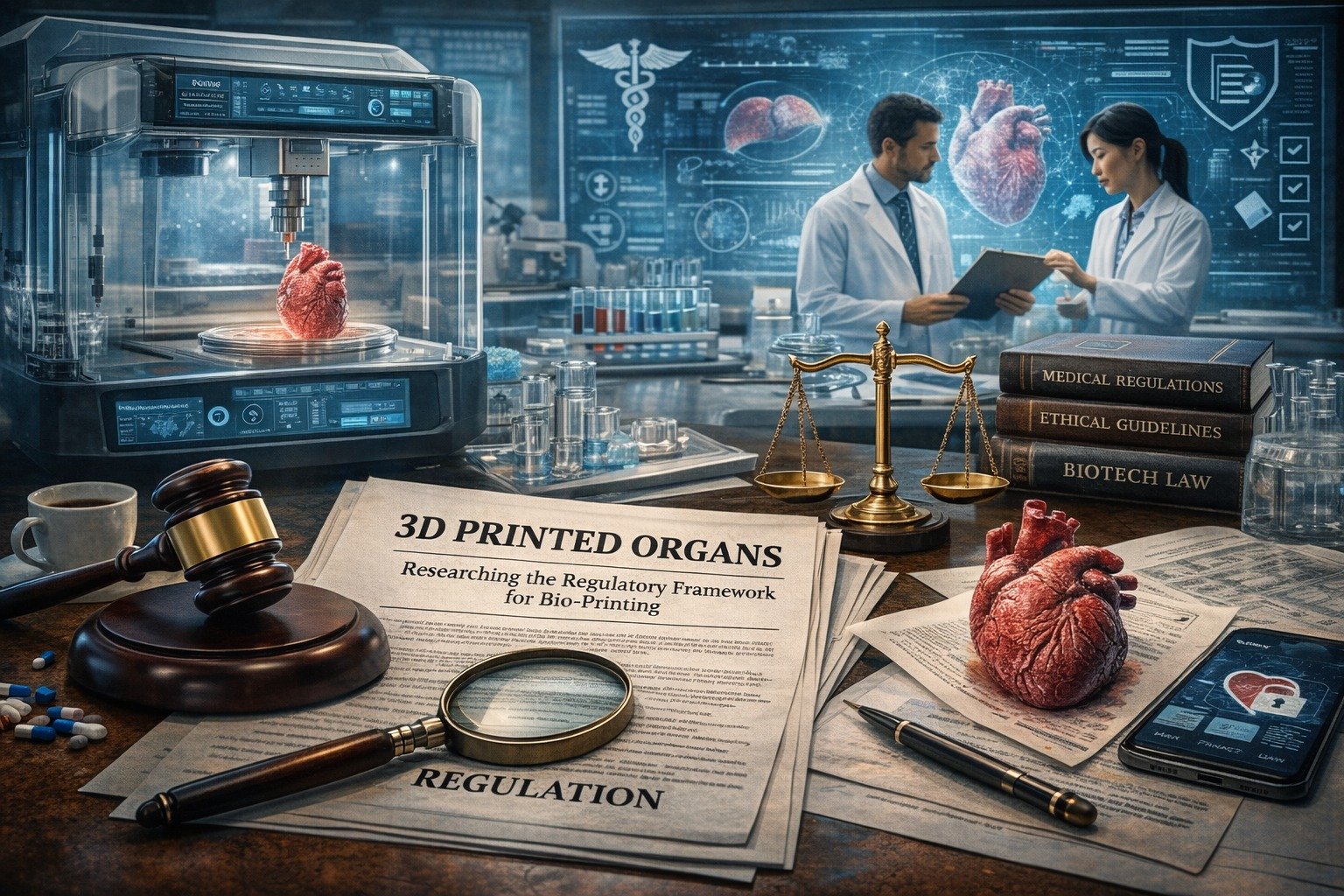
Medicine has always been shaped by technological breakthroughs, from antibiotics to organ transplantation. Today, another revolutionary development is beginning to reshape healthcare: 3D bioprinting. This technology allows scientists to print living tissues using specialized printers that deposit cells layer by layer, potentially creating functional human organs.
The promise of bioprinting is enormous. Millions of people worldwide suffer from organ failure, yet donor organs remain scarce. Long transplant waiting lists and organ rejection complications continue to challenge healthcare systems. If scientists can successfully print organs such as kidneys, hearts, or livers using a patient’s own cells, transplantation medicine could be transformed.
However, alongside the scientific excitement lies a complex legal and regulatory challenge. Traditional healthcare regulations were designed for pharmaceuticals, medical devices, and biological treatments, but 3D printed organs exist at the intersection of all three categories. Regulators must determine how to evaluate the safety, effectiveness, and ethical implications of bioprinted tissues.
This article explores the regulatory landscape surrounding 3D printed organs, examining how governments, legal institutions, and international organizations are working to build frameworks for this emerging biotechnology.
Understanding 3D Bioprinting
3D bioprinting is a specialized form of additive manufacturing that uses living cells and biomaterials to create biological structures. Unlike conventional 3D printing, which uses plastics or metals, bioprinting involves materials known as bioinks.
Bioinks typically consist of:
Living human cells
Hydrogels that support cell growth
Growth factors and nutrients
Structural biomaterials
A bioprinter deposits these materials layer by layer to create tissue structures that resemble natural organs.
Scientists are currently developing printed tissues such as:
Skin grafts for burn victims
Cartilage for reconstructive surgery
Bone implants
Liver tissue for drug testing
Blood vessels and heart tissue
Although fully functional printed organs are still under development, research progress is accelerating rapidly.
The Medical Need for Printed Organs
Organ shortages remain one of the most pressing challenges in modern healthcare.
Each year, thousands of patients die while waiting for organ transplants. Even when organs become available, patients may face complications such as immune rejection or long recovery periods.
Bioprinted organs offer several potential advantages:
Reduced Organ Shortage
If organs can be printed on demand, transplant waiting lists could be dramatically reduced.
Personalized Medicine
Bioprinted organs could be created using a patient’s own cells, reducing the risk of immune rejection.
Improved Drug Testing
Printed tissues can be used to test medications more accurately than traditional laboratory models.
Ethical Alternatives
Bioprinting could reduce reliance on animal testing in medical research.
Because of these benefits, governments and biotech companies are investing heavily in bioprinting research.
The Regulatory Challenge
The rapid development of bioprinting technology has created uncertainty about how printed organs should be regulated.
Traditional medical regulation divides healthcare products into categories such as:
Pharmaceuticals
Medical devices
Biological products
Tissue transplants
However, bioprinted organs may fit into multiple categories simultaneously.
For example:
The printer itself may be classified as a medical device.
The bioink may be considered a biological product.
The final organ resembles a transplantable tissue.
This complexity creates challenges for regulatory agencies responsible for approving medical treatments.
Regulatory Agencies and Bioprinting Oversight
Several major regulatory bodies are involved in shaping policies for bioprinting.
United States: FDA
The Food and Drug Administration (FDA) oversees medical products in the United States.
The FDA currently evaluates bioprinted products under its combination product framework, which applies to technologies that combine drugs, devices, and biological components.
Regulators examine factors such as:
Manufacturing processes
Cell sourcing methods
Sterility standards
Clinical safety and effectiveness
The FDA has also issued guidance for additive manufacturing technologies used in medical devices.
European Union: EMA
In Europe, the European Medicines Agency (EMA) plays a central role in regulating advanced medical therapies.
Bioprinted tissues may fall under the category of Advanced Therapy Medicinal Products (ATMPs).
This regulatory category includes:
Gene therapies
Cell-based therapies
Tissue-engineered products
The ATMP framework allows regulators to evaluate complex therapies involving living cells and biological materials.
International Standards
Global organizations such as the World Health Organization (WHO) and International Organization for Standardization (ISO) are working to develop technical standards for bioprinting.
These standards focus on:
Quality control in bioprinting processes
Safety testing procedures
Ethical guidelines for human tissue engineering
International coordination is important because bioprinting research occurs across multiple countries.
Manufacturing and Quality Control
One of the biggest regulatory challenges in bioprinting is ensuring consistent manufacturing quality.
Traditional pharmaceutical manufacturing follows strict processes to ensure that every batch of medicine is identical. However, bioprinted organs may vary depending on factors such as:
Cell quality
Printing precision
Environmental conditions
Scaffold materials
Regulators must determine how to maintain quality standards while allowing for biological variability.
Possible approaches include:
Advanced monitoring systems during printing
Strict bioink composition standards
Automated quality verification technologies
Ensuring reliable production processes will be essential before bioprinted organs can be widely used in hospitals.
Ethical Issues in Organ Bioprinting
Bioprinting raises several ethical questions beyond technical regulation.
Human Tissue Ownership
If a patient’s cells are used to print an organ, questions may arise about who owns the resulting biological structure.
Possible stakeholders include:
The patient
The medical institution
The biotechnology company that developed the printing process
Clear legal frameworks will be needed to define ownership rights.
Access and Equity
Bioprinted organs may initially be extremely expensive. This raises concerns that only wealthy individuals could access life-saving treatments.
Governments and healthcare systems must consider how to ensure fair access to advanced medical technologies.
Ethical Use of Human Cells
Bioprinting relies on human cells that may come from patients, donors, or stem cell sources.
Ethical guidelines are necessary to ensure that cell sourcing respects consent, privacy, and human dignity.
Intellectual Property and Patent Issues
Bioprinting technologies involve significant intellectual property considerations.
Companies developing bioinks, printing systems, and tissue engineering methods often seek patent protection for their innovations.
Potential patent categories include:
Bioprinting techniques
Bioink formulations
Scaffold materials
Organ design algorithms
However, patenting biological structures raises ethical debates. Some critics argue that life forms or biological tissues should not be privately owned.
Balancing innovation incentives with ethical concerns remains a challenge for patent law.
Clinical Trials for Bioprinted Organs
Before any medical treatment becomes widely available, it must undergo rigorous clinical testing.
Bioprinted organs will likely require multi-stage clinical trials similar to those used for pharmaceuticals.
These trials may involve:
Preclinical Research
Laboratory testing and animal studies to evaluate safety and functionality.
Phase 1 Trials
Small human studies focusing on safety.
Phase 2 Trials
Expanded studies evaluating effectiveness.
Phase 3 Trials
Large-scale clinical trials comparing new treatments with existing methods.
Because organ transplants involve life-or-death situations, regulatory agencies may apply particularly strict standards to ensure patient safety.
Cybersecurity and Digital Health Concerns
Modern bioprinting systems rely heavily on digital design files and computer-controlled manufacturing processes.
This introduces cybersecurity risks.
If malicious actors gained access to bioprinting systems, they could potentially alter organ design files or interfere with printing processes.
Regulators may need to introduce cybersecurity requirements for medical manufacturing systems.
These measures could include:
Secure data encryption
Access controls for design files
Monitoring systems for manufacturing integrity
Ensuring digital security will be an essential part of the regulatory framework.
The Future of Bioprinting Regulation
As bioprinting technologies continue to evolve, regulators will likely adopt more flexible and adaptive regulatory approaches.
Possible future strategies include:
Adaptive Regulation
Allowing regulators to update policies quickly as technology develops.
Regulatory Sandboxes
Creating controlled environments where companies can test innovative technologies under supervision.
International Cooperation
Developing shared standards across countries to streamline global approval processes.
These approaches could help balance innovation with safety and ethical oversight.
The Role of Artificial Intelligence in Bioprinting
Artificial intelligence is increasingly being used to design complex tissue structures and optimize printing processes.
AI algorithms can analyze biological data to determine the most effective ways to construct organs layer by layer.
However, AI-driven bioprinting introduces additional legal questions, such as:
Who is responsible if an AI-designed organ fails?
Should AI-generated biological designs be patentable?
How should regulators evaluate algorithmic decision-making in medical manufacturing?
These questions highlight the growing intersection between biotechnology and digital technology regulation.
Potential Impact on Global Healthcare
If bioprinting becomes clinically viable, its impact on healthcare could be enormous.
Potential benefits include:
Eliminating transplant waiting lists
Reducing organ rejection rates
Accelerating drug development
Personalizing medical treatments
However, achieving these benefits will require careful regulation to ensure patient safety and ethical integrity.
The success of bioprinting will depend not only on scientific breakthroughs but also on the development of robust legal frameworks.
Conclusion
3D bioprinting represents one of the most promising innovations in modern medicine. The ability to print living tissues and organs could transform transplant medicine, improve drug testing, and expand the possibilities of personalized healthcare.
Yet this technology also challenges existing legal and regulatory systems. Bioprinted organs blur the boundaries between medical devices, biological products, and tissue transplants, making it difficult for regulators to apply traditional rules.
Governments, healthcare institutions, and biotechnology companies must work together to develop regulatory frameworks that ensure safety, ethical responsibility, and equitable access.
As the field of bioprinting continues to advance, thoughtful governance will play a crucial role in shaping how this revolutionary technology benefits humanity.
The future of organ transplantation may not rely on donors alone but on sophisticated printers capable of producing living tissues on demand. Ensuring that this future unfolds safely and ethically will be one of the most important regulatory challenges of the coming decades.












Leave a Reply